Publication by Gallery Ocupa in Porto, Portugal, 2025. Text by me.
Translation to English:
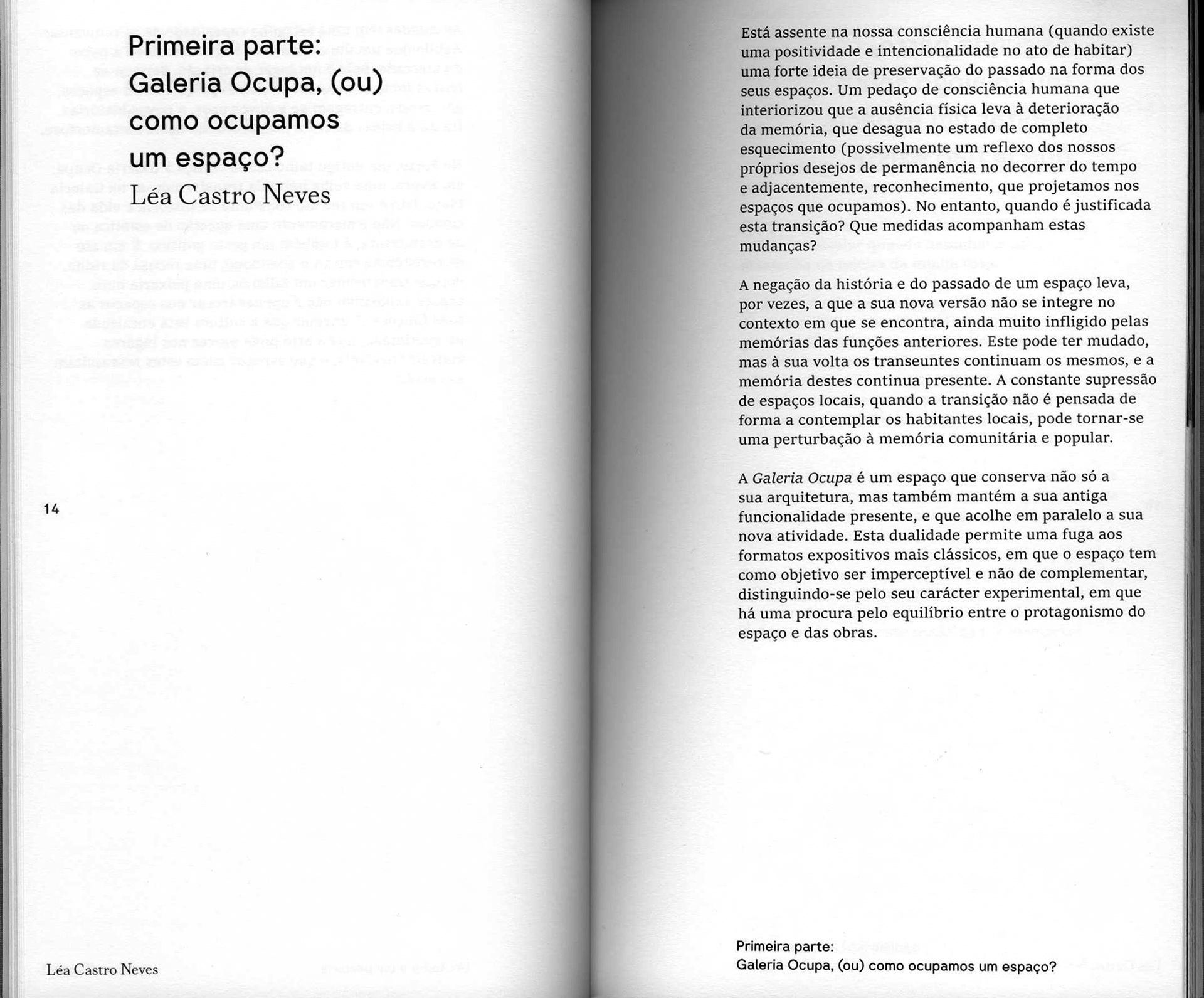
First part: Gallery Ocupa, (or) how do we occupy a space?
It is based in our human consciousness (when there is a positivity and intentionality in the act of inhabiting) a strong idea of preservation of the past in the form of its spaces. A piece and human consciousness that internalized that physical absence leads to the deterioration of memory, which flows into the state of complete oblivion (possibly a reflection of our own desires for permanence in the course of time and adjacently, recognition, which we project in the spaces that we occupy). However, when is this transition justified? What measures accompany these changes? The negation of the history and past of a space sometimes leads to its new version not being integrated into the context in which it is found, still very much inflicted by memories of previous functions.
This may have changed, but around it the passers remain the same, and the memory of these remains present. The constant suppression of local spaces, when the transition is not conceived in a way that contemplates the local inhabitants, can become a disturbance to the community and popular memory.
The Gallery Ocupa is a space that preserves not only its architecture, but also keeps its old functionality present, and which welcomes in parallel its new activity. This duality allows an escape to the more classic exhibition formats, in which the space aims to be imperceptible and not complementary, distinguishing itself by its experimental character, in which there is a search for balance between the protagonism of space and the work it holds.
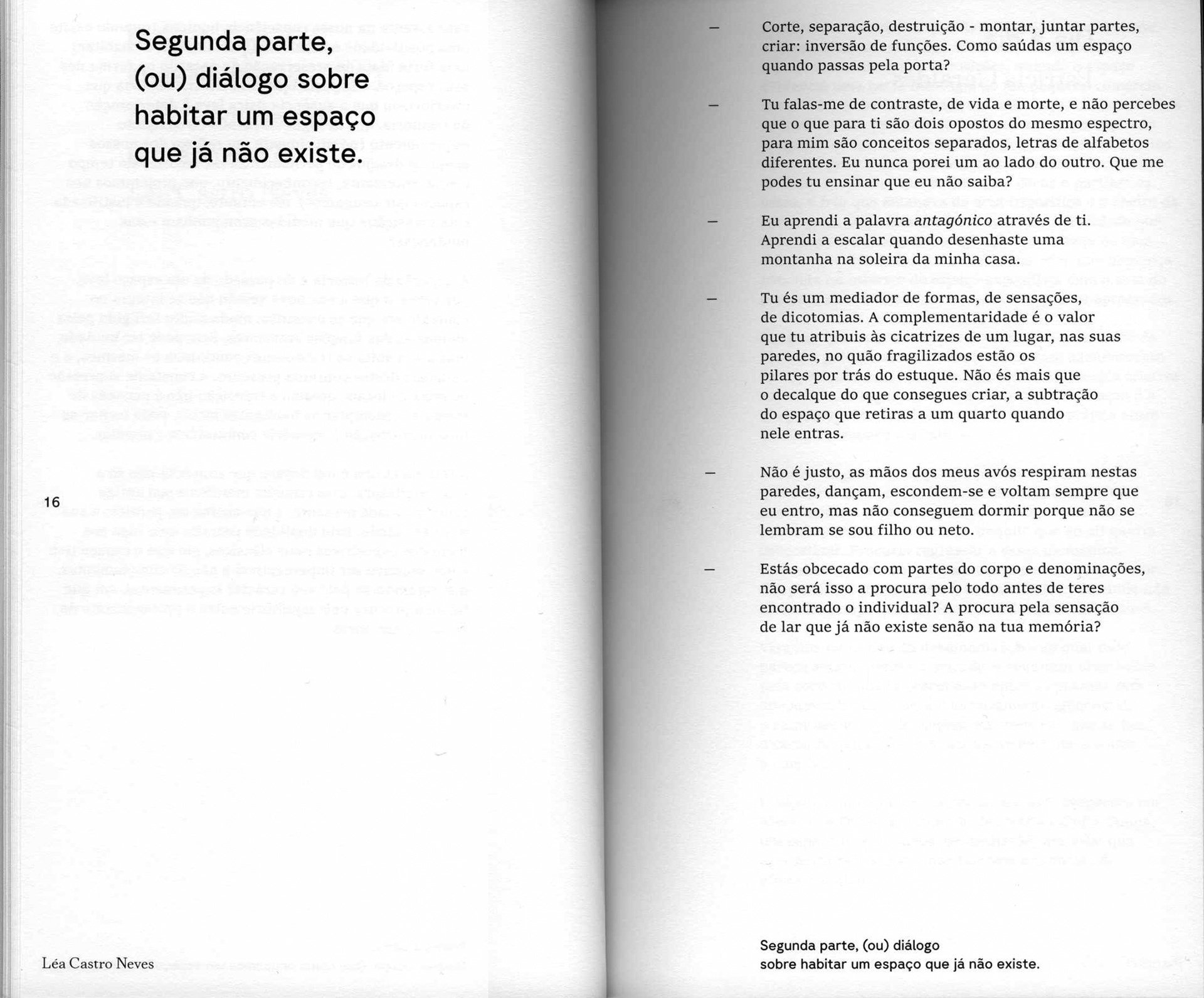
Part two, (or) dialogue about inhabiting a space that no longer exists.
- Cutting, separation, destruction - assembling, joining parts, creating: inversion of functions. How do you greet a space when you walk through the door?
- You talk to me about contrast, about life and death, and you don't realise that what for you are two opposites on the same spectrum, for me are separate concepts, letters from different alphabets. I will never put one next to the other. What can you teach me that I don't already know?
- I learned the word antagonistic through you. I learned to climb when you drew a mountain on my doorstep.
- You are a mediator of forms, of sensations, of dichotomies. Complementarity is the value you attribute to the scars of a place, on its walls, in how fragile the pillars behind the plaster are. You are nothing more than the imprint of what you can create, the subtraction of the space you take away from a room when you enter it.
- It's not fair, my grandparents' hands breathe on these walls, they dance, they hide and they always come back when I enter, but they can't sleep because they can't remember if I'm their son or their grandson.
- You're obsessed with body parts and names, isn't that the search for the whole before you've found the individual? The search for the feeling of home that no longer exists except in your memory?

